

Index funds vs ETFs gets argued about with more intensity than the actual differences justify. Both can track the exact same index. Both can hold nearly identical stocks in nearly identical proportions. The debate that matters isn’t returns — it’s a handful of structural differences in how each one trades, what it costs to get in, and how it’s taxed outside a retirement account.
Short version: the differences are in mechanics, not performance. Trading flexibility, minimum investment, and tax treatment in a taxable account — that’s the whole list.
What Each One Actually Is
An index fund is a strategy, not a structure — a fund built to track a market index like the S&P 500 rather than have a manager pick stocks. That strategy can be packaged as a traditional mutual fund or as an ETF. An ETF, meanwhile, is a structure, not a strategy — a fund that trades on an exchange like a stock, which can track an index (most do) or be actively managed (some are). The overlap is the confusing part: “index fund” often gets used casually to mean “index mutual fund,” when plenty of index funds are ETFs too.
Put another way: asking “index fund or ETF?” is a bit like asking “sedan or manual transmission?” One is a category of destination, the other is a mechanism for getting there, and the two questions don’t actually compete with each other. The real question hiding underneath is almost always about mechanics — trading, minimums, taxes — not about which one is the smarter investment.
Where They’re Basically the Same
An S&P 500 index mutual fund and an S&P 500 index ETF, from two different providers, can hold close to the identical 500 stocks in close to the identical weights. Expense ratios on the large, popular index products have compressed to nearly the same range too — often within a few hundredths of a percent of each other. For a lot of investors, this is the part that matters most and gets talked about least: picking the right index matters more than picking the wrapper it comes in.
The Differences That Are Actually Real
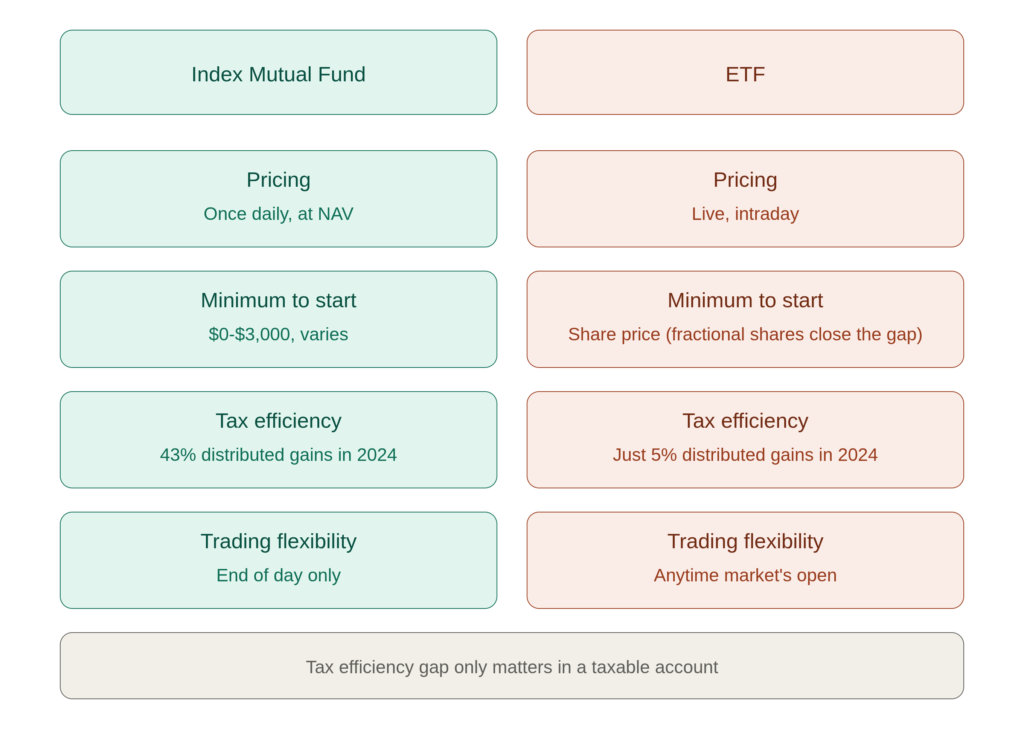
Per SEC guidance, mutual fund shares are bought directly from the fund (or a broker acting on its behalf) and priced once a day, after markets close, at net asset value. Nobody buying a mutual fund knows the exact execution price in the moment — it settles at whatever NAV comes out that evening. ETFs trade on an exchange all day at live market prices, the same way a stock does, which means the price can drift slightly above or below the fund’s actual NAV depending on supply and demand in the moment.
Minimums differ too, though less than they used to. Index mutual funds have historically required $1,000-$3,000 to open a position; many brokers have dropped that to $0 for their own house funds, while still charging that same minimum on funds from a competing provider. ETFs trade at whatever the share price is — sometimes $400, sometimes $40 — though fractional-share trading, now common at most major brokers, has largely erased this as a real obstacle either way. Someone with $100 to start can generally get into either one at most brokers today; the $1,000-minimum mutual fund is becoming the exception rather than the rule.
Tax efficiency in a taxable account is where the gap is most real. ETFs typically create and redeem shares through in-kind exchanges of securities rather than cash, which — per the same SEC guidance — tends to produce fewer taxable capital gains distributions than a comparable mutual fund. Industry data from State Street Global Advisors put a number on this for 2024: only about 5% of ETFs distributed any capital gains at all that year, versus roughly 43% of mutual funds. None of this matters inside a 401(k), IRA, or other tax-advantaged account, though, where nothing gets taxed annually regardless of which structure holds the index — the entire advantage lives specifically in a regular taxable brokerage account.
There’s a fourth difference worth knowing that rarely makes the standard comparison lists: the bid-ask spread. Since ETFs trade like stocks, every trade crosses a small gap between what buyers are offering and what sellers are asking. On a heavily traded fund tracking the S&P 500, that spread is usually a fraction of a penny — negligible. On a thinly traded, niche ETF, it can be wide enough to quietly eat into returns on every single trade. Mutual funds don’t have this issue at all, since every buy or sell transacts directly at NAV. It’s a minor point for large, popular funds and a real one for anything obscure.
Probably an Index Mutual Fund If…
- Automatic recurring investments matter — mutual funds have historically been easier to set up for scheduled contributions of an exact dollar amount, including fractional shares, at every major broker.
- The account is tax-advantaged (401(k), IRA), so the tax-efficiency gap with ETFs doesn’t apply anyway.
- Trading at intraday prices has zero appeal — end-of-day NAV pricing is simpler to reason about for a buy-and-hold investor who isn’t watching the market during the day.
Probably an ETF If…
- The account is a regular taxable brokerage account, where the tax efficiency gap actually shows up.
- Trading flexibility matters — the ability to buy or sell at a specific price during market hours, not just at end-of-day NAV.
- The broker doesn’t offer a $0-minimum index mutual fund and fractional ETF shares are available instead, closing the minimum-investment gap entirely.
Where This Trips People Up
- Assuming “index fund” always means “mutual fund” — plenty of the most popular index products on the market are actually ETFs, and the terms get used interchangeably even when they shouldn’t be.
- Chasing the tax-efficiency argument inside a retirement account, where it doesn’t apply at all — the entire advantage is specific to taxable accounts.
- Comparing two funds tracking different indexes and attributing the performance gap to “ETF vs. mutual fund” structure, when the actual driver was which index got tracked.
- Paying a trading commission on an ETF purchase without checking first — most major brokers offer commission-free ETF trades now, but it’s not universal, and a small fee on a small, frequent purchase adds up.
Before Picking Either One
None of this matters much without a basic handle on what a brokerage account actually is and how to fund one in the first place. Starting from scratch, that’s the place to begin: our guide to investing with little money covers opening an account and making a first contribution before any of this index-vs-ETF decision even comes up.
And since an index fund or ETF is really just a basket of underlying assets, it’s worth being clear on what’s actually inside that basket beforehand. If stocks and bonds still blur together conceptually: how stocks and bonds actually differ covers that distinction directly.
The Actual Decision
Pick the index first. Pick the wrapper — mutual fund or ETF — based on the account type and whether recurring automatic investing or intraday trading matters more. Both routes, done consistently, tend to land in roughly the same place over a long enough timeline. The wrapper is a footnote to the decision, not the headline, no matter how much space this particular debate takes up online.
Disclaimer: none of this is personalized investment advice — for guidance specific to your situation, a financial advisor or tax professional is the right call.