

How to open a brokerage account is the easy part. It takes maybe fifteen minutes online, most of it spent typing in information that’s already memorized. What actually determines whether the account does anything useful happens after that — and it’s the part most guides gloss over on the way to wrapping up.
Short version: gather a handful of details beforehand, get through an application built around identity-verification law rather than anything investing-specific, fund it, and then — critically — actually put the money into something.
Before Starting: What Gets Asked For
Have these on hand before opening the application, and the whole thing takes minutes instead of turning into a scavenger hunt halfway through: Social Security number, a government-issued ID, current address, employer name and address (or “not employed” / “student” / “retired”), and a way to fund the account — a linked bank account and routing number covers most of it.
One decision has to happen before the form even opens: taxable brokerage account, or an IRA opened through a brokerage. A taxable account has no contribution limits and no rules about withdrawals, but offers no tax advantages. An IRA caps yearly contributions and restricts early withdrawals, in exchange for tax-advantaged growth. Plenty of people eventually want both; picking which one to open first just depends on whether the money is for a general goal or specifically retirement.
Minor detail, easy to overlook: the account has to be opened in one specific legal name, matching the ID exactly. A recently married name, a nickname used everywhere else, a middle name usually dropped — none of that matters here. Whatever’s printed on the government ID is what goes on the form.
Which Brokerage, Though
Commission-free stock and ETF trading is standard at most major brokerages now, which used to be the first differentiator and mostly isn’t anymore. What still varies: account minimums (many are $0 to open), mutual fund selection and fees, research tools, and how the mobile app actually feels to use day to day. For a first account, the honest answer is that the difference between the handful of large, well-known brokerages matters far less than actually opening one and using it. Obscure or unfamiliar platforms are where more diligence is worth spending time — an established name with a long track record is rarely the wrong first choice.
What the Application Is Actually Asking, and Why
Why does opening an account require a Social Security number? Per FINRA, federal law requires financial institutions to collect and verify four specific pieces of information — name, date of birth, address, and an identification number — before opening an account, as part of anti-money-laundering rules commonly traced back to the Patriot Act. Every legitimate brokerage asks for the same four things because the law requires it, uniformly, across the entire industry.
Then comes a section that feels more like a personality quiz: investment experience, risk tolerance, annual income, net worth, investment objectives. The firm uses these answers to classify the account for suitability purposes, and some order types and investment products get restricted based on what’s entered here — which is exactly why answering honestly, rather than aspirationally, actually matters. Overstating investment experience to unlock advanced features nobody plans to use doesn’t help anyone; it just misrepresents the account’s own risk profile back to the firm managing it.
Near the end: beneficiary designation (who inherits the account — worth taking seriously even at 25), and an electronic signature agreeing to the account terms. Submit, and most online brokerages approve accounts within a day, sometimes instantly.
Funding It
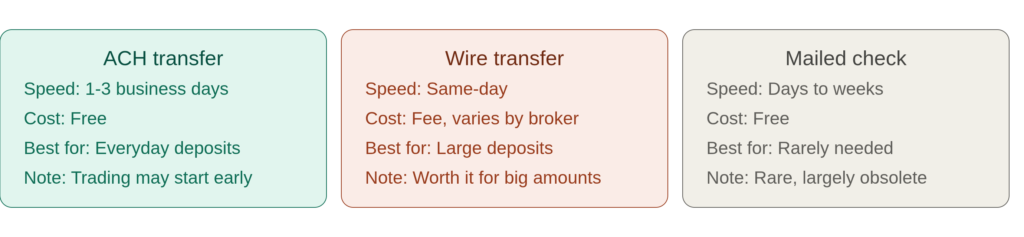
An ACH transfer linked from a bank account is the standard, free method — usually 1 to 3 business days to fully clear, though many brokerages let trading begin against a pending transfer before it fully settles. Wire transfers move same-day but often carry a fee, worth it mainly for large initial deposits. A mailed check works too, just slower, and mostly a non-issue at this point given how rarely it gets used.
Worth knowing before that first deposit lands: per SIPC, brokerage accounts are protected up to $500,000 if the brokerage itself fails, including a $250,000 sub-limit specifically for uninvested cash sitting in the account. This isn’t protection against investment losses — the market can still do whatever it does — it’s protection against the brokerage itself going under.
That distinction trips people up. Losing money because a stock dropped is a normal, expected part of investing, and SIPC does nothing about it. SIPC exists for the much rarer scenario where the brokerage itself collapses and customer assets go missing or unaccounted for — a real but uncommon event, and one that’s worth knowing the protection exists for without spending much time worrying about it.
The Step That Actually Gets Skipped
A funded brokerage account with nothing purchased inside it is functionally a low-interest savings account, minus even the modest interest. This is the single most common mistake with a first brokerage account: opening it, funding it, and then never actually buying anything — sometimes for months, occasionally for years — because the next decision (what to actually invest in) felt like a separate project for another day.
It doesn’t have to be complicated to not be nothing. For a first move that doesn’t require picking individual stocks: our guide to investing with little money covers getting started without overthinking the first purchase.
And before choosing what specifically to buy inside the account, it helps to know what’s actually being compared. If stocks and bonds still feel interchangeable: how stocks and bonds actually differ covers that groundwork directly.
Where This Goes Sideways
- A name mismatch between the ID and the application — a recent legal name change not yet updated everywhere is a common, fixable delay, not a rejection.
- Opening a margin account by default without meaning to. Some brokerages set margin as the default account type during signup; a cash account is the simpler, safer choice for a first account unless margin trading is specifically the goal — margin means borrowing against the account’s own holdings to buy more than what’s actually funded, with the risk that entails.
- Funding the account and stopping there, covered above — worth repeating because it’s genuinely the most common outcome, not a rare misstep.
- Skipping the beneficiary field because it feels premature. It takes thirty seconds and avoids a genuinely painful process for whoever would otherwise have to sort it out later.
Fifteen Minutes, Then the Actual Work
The application itself is the least important part of this entire process, despite being the part most guides spend the most time on. Getting approved and funded is a formality. What happens with that money in the weeks after is the part that actually determines whether opening the account was worth doing at all. An account that sits open and funded for a year with nothing purchased inside it has accomplished roughly nothing — the fifteen minutes of setup were never really the hard part.
Worth a quick note here: which one fits better depends on the full financial picture — this is general information, not personalized advice.