

“Free money” is the phrase attached to every 401k employer match explained by a well-meaning coworker, an HR slideshow, or a personal finance headline. It’s not wrong, exactly. It’s just incomplete. The match comes with rules about timing, vesting, and opt-in that don’t show up in the pitch — and missing any one of them is how people leave real dollars behind while thinking they’re already collecting the full match.
Short version: whether the match is automatic, how much it’s actually worth, and the fine print that quietly voids part of it — vesting, timing, and how the formula itself is written. Each is covered below.
Decoding the Formula First
Benefits paperwork tends to describe the match in phrasing that reads like a fraction problem: “50% up to 6%,” or “dollar-for-dollar up to 3%.” Translated, “50% up to 6%” means the employer contributes 50 cents for every dollar contributed, capped once contributions reach 6% of salary. On a $60,000 salary, contributing the full 6% ($3,600) gets a $1,800 match. Contributing less than 6% gets a proportionally smaller match; contributing more than 6% doesn’t grow the match at all — it caps at that 6% mark regardless of how much extra goes in.
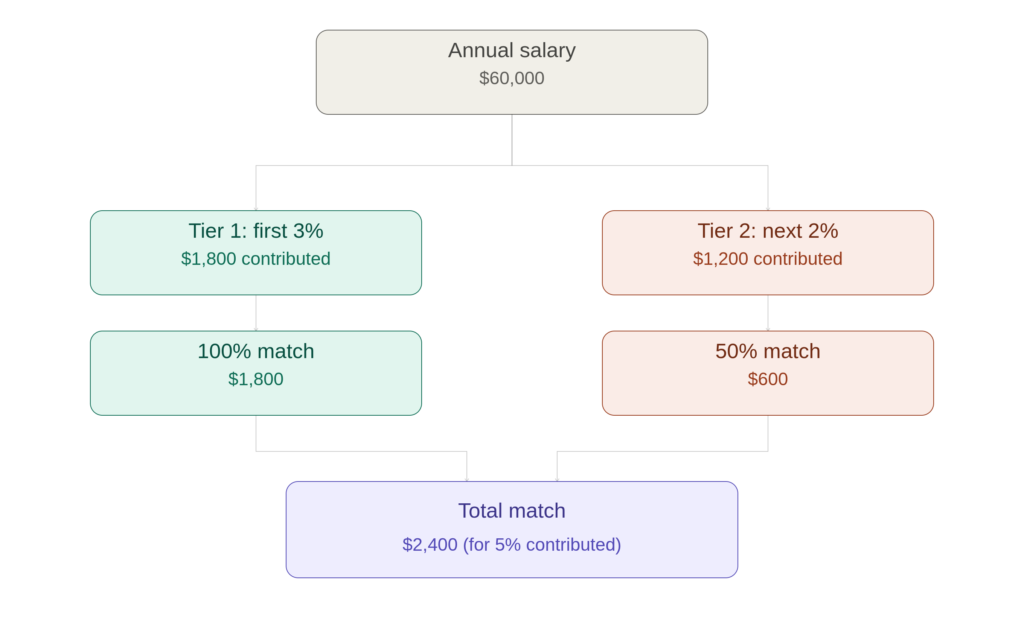
Tiered formulas stack two different match rates on top of each other — something like “100% on the first 3%, then 50% on the next 2%” — and are worth running through the actual plan document once rather than assuming a single flat percentage applies.
Myth: It’s Automatic
Not always. Some plans enroll employees automatically at a default contribution rate — often 3%, sometimes lower than the rate needed to capture the full match. Anyone who never actively checked or adjusted that default could be sitting well under the match threshold without realizing it. Worth logging into the plan provider’s site once and confirming the actual contribution percentage against whatever the formula requires.
Myth: More Is Always Better
Contributing beyond the match cap is still good — tax-advantaged growth doesn’t stop mattering just because the match does. But it’s not “more free money” past that point. An employer matching “50% up to 6%” isn’t going to match 10% just because someone decides to be aggressive. The match caps exactly where the formula says it caps, full stop.
Myth: Vesting Doesn’t Matter
It matters a lot, and it’s the part almost nobody reads. Vesting is the schedule that determines when employer-contributed money actually becomes fully owned — leave before that point, and the unvested portion of the match reverts to the employer. Personal contributions are always 100% vested immediately; it’s specifically the employer’s match that can be on a schedule. Per IRS guidance on vesting standards, the legal minimum since the Pension Protection Act of 2006 is either 3-year cliff vesting (0% owned until year three, then 100% all at once) or 6-year graded vesting (a rising percentage each year, fully vested by year six). Plans are allowed to be more generous than that minimum — some vest immediately — but nothing requires them to be.
A job change at year two under a 3-year cliff schedule means walking away from every dollar of match ever received. That’s not a rounding error.
Myth: It Doesn’t Matter When Contributions Happen
Most employer matches run per paycheck, not per year — contribute 6% this paycheck, get the match this paycheck. That creates a trap for anyone who front-loads contributions to hit the annual IRS limit early in the year: once the personal contribution limit is reached, contributions (and the paycheck-by-paycheck match tied to them) stop for the rest of the year. A high earner maxing out by August, for instance, might go four months with no contributions at all — and, on a plan without a fix, four months with no match either, even though the annual dollar total they contributed was exactly the same as someone who spread it evenly.
Some plans fix this automatically with a “true-up” — a year-end employer contribution that makes up whatever match was missed from front-loading. Plenty of plans don’t offer one. It’s worth asking HR directly whether a true-up exists before assuming front-loading is free of downside; the answer determines whether spreading contributions evenly across the year actually matters or is safe to ignore.
The Roth Wrinkle
For a long time, employer match money was pre-tax no matter what — even inside a Roth 401(k), the personal contributions went in after-tax while the match landed in a separate traditional bucket, taxed later on withdrawal. SECURE 2.0 changed that starting in late 2022: plans can now optionally let employees designate the match itself as Roth. Under IRS rules, that Roth-designated match is taxable in the year it’s made (unlike a normal pre-tax match) and gets reported on a 1099-R — the tax form used for reportable distributions from a retirement account — rather than the W-2 used for regular wages. Not every plan offers this option yet. Whether it’s worth electing depends on the same pre-tax-versus-Roth math that applies to personal contributions — current tax bracket versus expected bracket in retirement.
What the Match Is Actually Worth
On that same $60,000 salary with a 50%-up-to-6% formula, the match is $1,800 a year — guaranteed, no market risk, no strings beyond staying employed long enough to vest. Over a 30-year career with modest investment growth, that annual $1,800 compounding alongside personal contributions turns into a genuinely large chunk of an eventual retirement balance, separate entirely from whatever gets personally saved. It’s also worth remembering the match doesn’t count against the IRS’s personal contribution limit — for 2026, that personal limit rose to $24,500, and employer match contributions sit entirely outside that number.
Once the Match Is Locked In
Getting the full match is step one. What that money actually gets invested in inside the account is a separate decision, and it’s the one that determines most of the long-term outcome. If that part still feels unfamiliar: our guide to investing with little money covers the basics of what to actually do with money once it’s inside an account like this.
The Check Worth Running Today
Pull up the plan document or ask HR three questions: what’s the exact match formula, what’s the vesting schedule, and is there a true-up. Five minutes, and it either confirms the full match is already being captured or reveals a gap that’s been quietly leaving money unclaimed.
Note: Retirement plan limits and rules can change. Verify current information with the IRS or other official sources, and consult a qualified tax or retirement professional when needed.