

A full year of 1099 income, nothing withheld, and then a tax bill that’s thousands of dollars bigger than expected. That’s how freelance taxes for beginners usually show up — as a surprise, even though every part of the number was calculable months earlier. This walks through the actual math, once, with one dollar figure carried the whole way through so it stays concrete instead of a percentage floating in the air.
Quick disclaimer: this is how the math works, not personalized advice. Real brackets, state taxes, and deductions vary enough that the IRS’s own Form 1040-ES worksheet — or an actual accountant — gets the final say on an exact number.
The Example
A freelancer nets $60,000 in 1099 income this year, after expenses, with nothing else major coming in. Everything below is built on that number.
First question worth answering: what actually counts as freelance income? All of it, regardless of whether a form shows up to document it. A 1099-NEC arrives from any client who paid $600 or more; a 1099-K might arrive from a payment platform past certain thresholds. But the paperwork doesn’t create the obligation — the income does. Cash, Venmo transfers, a client who never files anything at all. Still taxable, every time. The IRS doesn’t care whether a form was generated; it cares whether money came in for work performed.
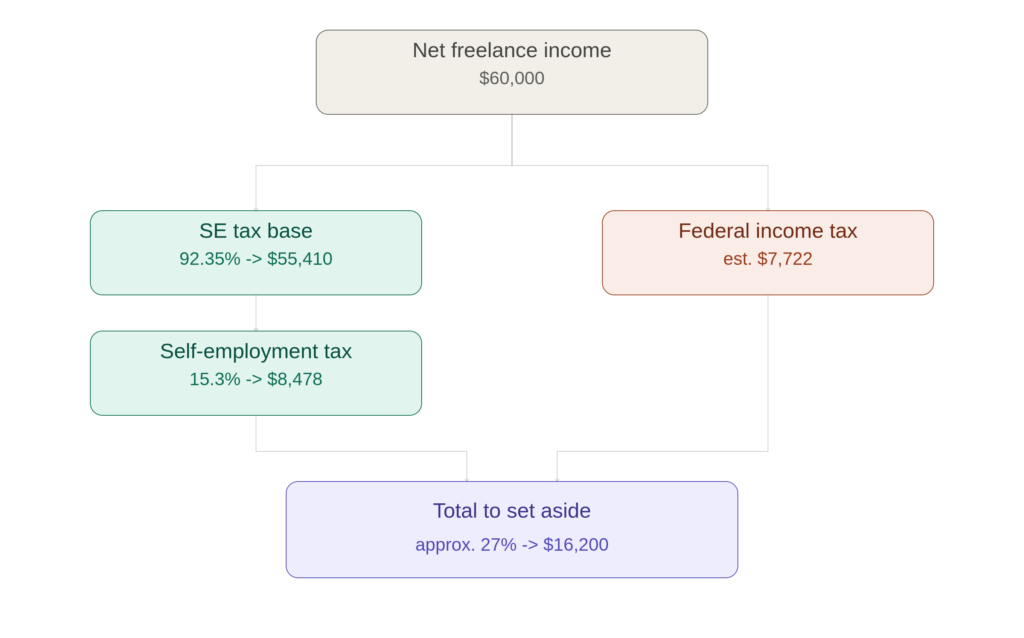
92.35%
Self-employment tax isn’t calculated on the full $60,000. It’s calculated on 92.35% of it — an old adjustment meant to roughly mirror how payroll tax works for a regular employee, where an employer normally covers half. Self-employed, no employer, so the adjustment approximates that gap instead.
- $60,000 × 92.35% = $55,410. That’s the actual base self-employment tax runs against — not the full $60,000.
The Self-Employment Tax Bill
Per the IRS, the rate is 15.3% total: 12.4% Social Security, 2.9% Medicare. Social Security stops applying past the annual wage base ($184,500 for 2026). Medicare never stops — no cap, no ceiling, applies to every dollar of self-employment income no matter how high it climbs.
- $55,410 × 15.3% = $8,477.73, call it $8,478. Nowhere near the Social Security cap here, so the full rate hits the entire amount.
Small mercy: half of that, about $4,239, is deductible against income tax — the “employer-equivalent” half, per the same IRS page.
Then Regular Income Tax, Separately
Self-employment tax pays for Social Security and Medicare. Income tax is a different bill entirely, and it still applies to freelance earnings the same way it would to a paycheck — standard deduction, brackets, whatever other deductions or credits apply. Brackets are progressive, so only the income sitting inside a given bracket gets taxed at that bracket’s rate. Two freelancers earning the identical $60,000 gross can land on meaningfully different income tax bills once filing status, other income, and deductions get factored in.
State income tax stacks on top of both, where it applies. A handful of states charge none at all; most charge something in the low single digits to around 10%, depending on the state and the income level. Worth checking once, then filing away — it rarely changes year to year unless a move happens.
Where 25-30% Comes From
The commonly used starting estimate — set aside 25-30% of net freelance income for taxes, full stop — comes from adding both bills together. At $60,000, that’s $15,000 to $18,000. Split the difference at 27% and it’s $16,200.
- $60,000 × 27% = $16,200 to set aside for the year.
Roughly $8,478 of that is the self-employment tax already calculated above. The remaining $7,722 covers income tax — about a 13% effective rate on $60,000, plausible for a single filer taking the standard deduction with no other income in the mix. Higher earners in higher brackets should expect the percentage to climb; anyone with real deductions, dependents, or credits should expect it to come down. As income grows year over year, it’s worth re-checking this percentage rather than assuming the same 27% still fits — brackets shift, and so does the math.
Paying It Quarterly
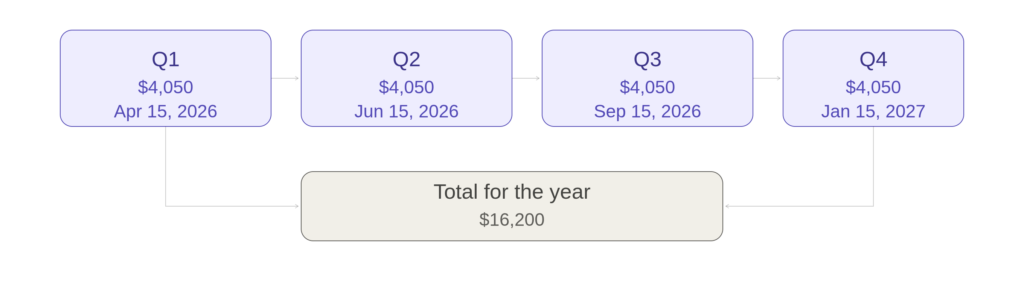
The IRS doesn’t wait for April. Anyone expecting to owe $1,000 or more after withholding generally owes quarterly, per the IRS’s estimated tax guidance, on this schedule for 2026:
| Period Covered | Due Date |
| Jan 1 – Mar 31 | April 15, 2026 |
| Apr 1 – May 31 | June 15, 2026 |
| Jun 1 – Aug 31 | September 15, 2026 |
| Sep 1 – Dec 31 | January 15, 2027 |
$16,200 split evenly across four payments is $4,050 a quarter. Freelance income rarely lands in even chunks, though, so adjusting each payment up or down based on what actually got earned that quarter is fine — the bar is reasonably even coverage across the year, not four identical checks.
IRS Direct Pay handles this directly from a bank account, free, no enrollment required, maybe five minutes once account details are on hand. It’s worth knowing that individual taxpayers are being shifted off the older EFTPS system during 2026 in favor of Direct Pay and IRS Online Accounts — so Direct Pay is the more durable option to build a habit around right now, not just the easier one.
There’s a cushion built into all of this, usually called the safe harbor rule. Underpayment penalties are generally avoided by paying at least 90% of the current year’s tax, or 100% of last year’s total tax (110% above $150,000 in prior-year income), whichever is smaller. A freelancer whose income is climbing fast can lean on last year’s smaller number as a safe quarterly target instead of guessing at a moving current-year figure. It’s a forgiving rule. Use it.
What Actually Lowers the Bill
None of the math above accounts for deductions tied specifically to running freelance work.
- Home office deduction, if part of a home is used regularly and exclusively for the work.
- Self-employed health insurance premiums — often deductible even without itemizing.
- SEP-IRA or Solo 401(k) contributions, which cut taxable income now and build retirement savings at the same time.
- Ordinary business expenses: software, equipment, a slice of internet and phone bills, mileage.
Every one of these has rules and limits attached, and that’s where a tax professional starts earning their fee. Ordinary business expenses reduce net profit before the 92.35% calculation even starts, so they touch both bills at once. Health insurance premiums and retirement contributions only reduce income tax, not self-employment tax — a distinction that trips people up more than it should. Mileage in particular is easy to undercount; a logged trip to meet a client or pick up supplies adds up faster across a year than most people assume when they’re not writing it down as it happens.
Where This Goes Wrong Most Often
- Spending the money as it arrives, nothing set aside — by the time a quarterly payment or the April bill shows up, the cash is already gone. A separate account that automatically pulls a percentage off every payment fixes this before it starts.
- Skipping quarterly payments and trying to settle everything in April. Usually triggers an underpayment penalty on top of the tax itself, and it’s entirely avoidable.
- Treating self-employment tax and income tax as one number instead of two stacked bills — budgeting for one and getting blindsided by the other.
- Not tracking expenses as the year goes, then trying to reconstruct twelve months of spending from memory in April. A spreadsheet updated monthly beats a receipt archaeology project.
Part of a Bigger System
Setting aside tax money on every payment only sticks if irregular income already has somewhere structured to go — otherwise it blends into regular spending before a deadline ever shows up. That’s less a tax problem than a cash-flow one, and it’s usually the real reason a freelancer ends up short in April despite meaning to save all along. Worth sorting out first, if it isn’t already: our guide to saving and investing side hustle earnings covers routing irregular income so it doesn’t all read as spendable cash the moment it lands.
The Short Version
25-30% of net income, set aside as it’s earned, paid quarterly. That’s close enough to build a habit around in year one. The exact percentage sharpens over time as real numbers and real deductions come into focus — and by year two or three, this stops being a scramble and just becomes part of getting paid.
Three numbers in the article change annually: the Social Security wage base, the 1099-K threshold, and quarterly payment due dates. Verify them with official government sources, and consult a tax professional when needed.